In high-precision test environments, robotic integration requires more than repeatable movement: it demands controlled interaction with measurement systems. Each trajectory must be synchronized with test equipment, whether it’s a vision trigger, an RF probe, or a force application.
The motion itself becomes a variable in the measurement chain, and it must be designed accordingly.
Averna engineers motion not as a standalone capability, but as a calibrated component of the test sequence. Robot paths are shaped around the test timing: acceleration curves are adapted to avoid microvibrations, and dwell times are tuned to match measurement acquisition windows. Each movement is validated through kinematic modeling to ensure sub-micron repeatability, particularly when positioning over contact pads or optical targets.
Key Constraints for Test-Grade Robotic Systems
We design robotic systems to meet strict test constraints such as:
- Micron-level repeatability even during continuous motion
- Synchronization between robot movement and data acquisition
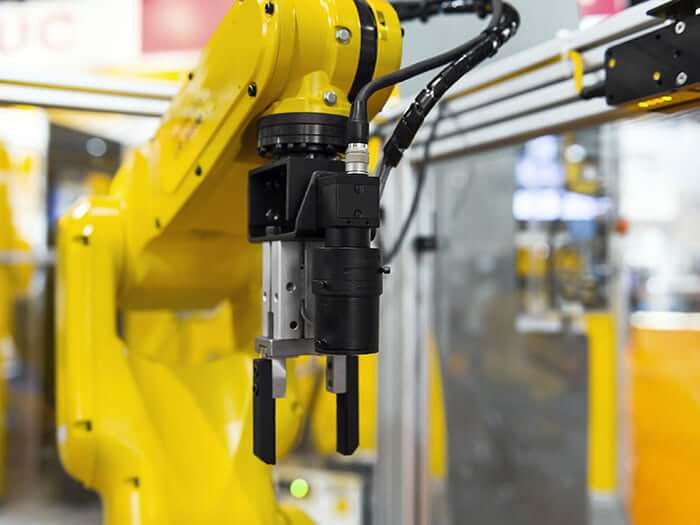
- Custom end-effectors that combine handling and measurement precision
- Thermal and vibrational stability to prevent measurement drift
- Integrated safety and traceability across all subsystems
 Customized end-effectors are developed in-house to manage both mechanical handling and the test interface. To apply pressure to a flexible PCB or align a lens stack for inspection, the tooling is optimized for signal fidelity and mechanical compliance. Integration extends to real-time synchronization between robot controllers and acquisition systems - including cameras, DAQs or motion sensors - to avoid data distortion.
Environmental drift is neutralized by material selection and live correction. Structures are thermally stable and, if necessary, active compensation is implemented to counteract chassis deformation or ambient variations. Safety is built into the control architecture, with all systems (robotics, conveyors, vision, test benches) linked by a unified PLC layer designed for test-quality automation and total traceability.
This level of integration transforms the robotics of a conveyor mechanism into a critical component of the test function itself.
Robotics for Inline Product Testing
Typical applications span industries where test cycles must follow the product in motion — electronics, automotive, medtech, or semiconductors — and involve real-time decisions on fast-moving units.
This includes:
- Line-scan inspection synchronized with linear drives
- Ink dispersion validation on moving substrates
- Continuous 3D surface profiling for defect detection
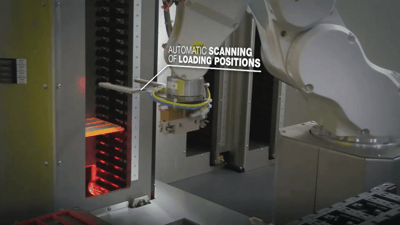
Watch the video below to see these principles in action through one of our PCBA test solutions — a fully integrated, vision-guided system engineered for speed, reliability, and product traceability.